Building a Safer HVAC Fleet in Central Florida
HVAC fleet safety affects nearly every part of a contracting business.
Service trucks transport employees, tools, refrigerant, replacement parts, recovery equipment, and customer property. They also travel through congested roads, residential neighborhoods, construction zones, school zones, and unfamiliar job locations.
One preventable accident can injure an employee or member of the public, damage several vehicles, remove an HVAC truck from service, delay appointments, and create a complicated insurance claim.
For HVAC companies working throughout Polk County, Osceola County, and Highlands County, fleet safety should be managed as an important business system.
It cannot be reduced to telling technicians to drive carefully.
A strong program addresses driver selection, training, dispatching, vehicle condition, cargo securement, accident reporting, and insurance.
Why HVAC Service Trucks Create Significant Risk

An HVAC service truck is a moving workplace.
The technician may receive calls from customers and dispatchers, follow unfamiliar directions, think about the previous repair, and worry about arriving late to the next appointment.
The vehicle may contain refrigerant cylinders, recovery machines, vacuum pumps, ladders, compressors, motors, diagnostic tools, and replacement equipment.
That combination creates several exposures.
The company has responsibility for the employee driving the vehicle. It also has responsibility for maintaining the vehicle, establishing safe procedures, and avoiding business practices that encourage unsafe driving.
OSHA explains that employers should review whether dispatching, routing, workloads, or schedules contribute to distracted driving. Employers should provide enough time for employees to obey speed limits and respond safely to road conditions.
That matters when an HVAC technician is traveling between Lakeland and Winter Haven, Davenport and Kissimmee, or Sebring and Lake Placid.
A schedule that looks reasonable on a computer may not account for traffic, school zones, road construction, weather, fuel stops, or time needed to secure equipment.
Start With Driver Selection

A technician’s technical ability does not automatically make that person a safe driver.
Before authorizing an employee to operate a company vehicle, confirm that the employee has an appropriate and valid driver’s license. Review the motor vehicle record and evaluate the employee’s experience with the type and size of vehicle being assigned.
Review Driving Records Regularly
Driver screening should continue after hiring.
An employee may receive speeding tickets, license restrictions, suspensions, or serious violations after joining the company. Establish a schedule for reviewing motor vehicle records and require employees to report material changes promptly.
The company should establish written standards explaining which violations require:
- Additional training
- Restrictions
- Suspension of driving privileges
- Further review
Apply those standards consistently.
Confirm Insurance Eligibility
A driver may be legally licensed but unacceptable to the insurance carrier.
Before giving an employee regular access to a company vehicle, submit the driver’s information to the insurance agency or carrier when required. Do not wait until a claim to discover that a driver was excluded, unreported, or otherwise restricted under the policy.
Create a Written HVAC Fleet Safety Policy
A written policy explains what the company expects and gives managers a consistent process to enforce.
The policy should address:
- Authorized drivers
- Seat belt use
- Speeding and traffic laws
- Phone use and distracted driving
- Impaired and fatigued driving
- Vehicle inspections
- Preventive maintenance
- Personal use of company vehicles
- Passengers
- Tool and cylinder securement
- Towing trailers
- Accident reporting
- Traffic violations
- Disciplinary procedures
- Driver training
Employees should review and sign the policy before operating a company vehicle.
A signed policy alone is not enough. Supervisors and owners must follow the same rules and enforce them consistently.
Prevent Distracted Driving
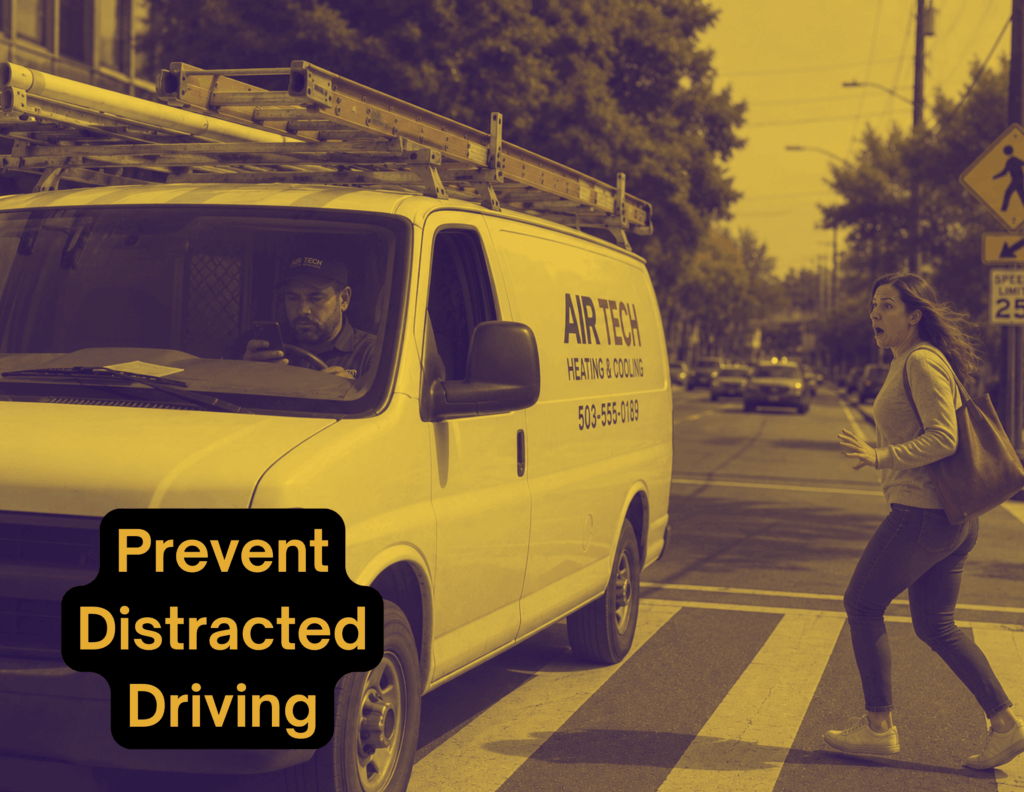
HVAC technicians use phones for GPS directions, customer communication, photographs, invoices, dispatching, timekeeping, and service documentation.
Those tools improve productivity, but they also create distraction.
OSHA advises drivers to avoid using a phone while driving and to pull into a safe area before making a call or sending a message.
Make Dispatch Part of the Solution
A distracted driving rule will fail if dispatchers expect an immediate response.
Train dispatchers not to repeatedly call or message a technician who may be driving. Use routing systems that allow technicians to receive the complete appointment information before leaving the previous location.
Technicians should safely park before reading detailed messages, entering addresses, uploading photographs, or responding to customers.
Florida reported more than 52,900 distracted driving crashes during 2025, according to the state’s 2026 safety campaign.
A company policy should address manual, visual, and mental distraction, not only texting.
Control Scheduling and Fatigue
Central Florida HVAC companies operate under intense pressure during summer.
A technician may begin early, complete several physically demanding service calls, spend time in extremely hot attics, and then drive across the county for another emergency.
A tired technician may have slower reactions and poor judgment.
Dispatchers should consider time spent in attics, workload, weather, distance, traffic, and the technician’s total working hours when assigning another call.
If an employee exits an attic feeling dizzy, weak, confused, or physically exhausted, that employee should not immediately drive to another appointment.
Inspect Service Trucks Before Driving
Drivers should complete a documented vehicle inspection before beginning the workday.
The inspection should include:
- Tires and visible tire damage
- Headlights, brake lights, and turn signals
- Windshield and wipers
- Mirrors and backup camera
- Seat belts
- Brakes and steering
- Warning indicators
- Visible fluid leaks
- Vehicle body damage
- Ladder racks and exterior attachments
- Tool and equipment securement
- Refrigerant cylinder condition and securement
Problems affecting safe operation should be reported immediately. The company must then decide whether the vehicle should be removed from service.
A checklist has little value if employees believe reporting a problem will get them blamed or leave them without a truck.
Secure Tools, Equipment, and Refrigerant
HVAC service vehicles may carry thousands of dollars in mobile property.
During a sudden stop or collision, unsecured equipment can move through the cargo area, damage the vehicle, or injure an occupant.
Recovery machines, vacuum pumps, cylinders, compressors, ladders, and heavy parts should have appropriate storage and securement.
Exterior ladders should be checked before every trip. Refrigerant cylinders should be identified, protected, transported, and secured according to applicable requirements and manufacturer instructions.
Companies transporting regulated materials should determine which federal and state transportation requirements apply to their operations.
Reduce Backing and Parking Accidents
Not every costly accident happens at highway speed.
An HVAC technician can back into a customer’s vehicle, garage door, fence, landscaping, mailbox, or equipment.
Require technicians to walk around the vehicle before backing. Drivers should identify children, pets, low objects, overhangs, and other hazards.
Use a spotter when one is available. The driver and spotter should agree on signals before movement begins.
When practical, drivers can back into a parking space upon arrival so they have better visibility when leaving. However, the driver must first confirm that backing can be completed safely.
Establish an Accident Response Procedure
Drivers should know what to do before an accident happens.
The company’s accident kit should include instructions, insurance information, emergency contacts, and a method for documenting the scene.
After an accident, the driver should:
- Stop in a safe location when possible.
- Call emergency services when needed.
- Avoid admitting fault or arguing.
- Exchange required information.
- Photograph the vehicles and surrounding area safely.
- Identify witnesses.
- Notify company management promptly.
- Report injuries or symptoms.
- Protect tools and customer equipment.
- Cooperate with the company’s reporting process.
Management should notify the insurance agency or carrier promptly and preserve vehicle, GPS, camera, dispatch, maintenance, and driver records.
How Insurance May Respond
Commercial Auto Insurance
Commercial auto may respond when a covered vehicle or driver causes bodily injury or property damage. Physical damage coverage may protect an insured vehicle against covered collision, theft, weather, or other losses, depending on the selected coverage.
Every owned vehicle, regular driver, trailer, and relevant operation should be disclosed and reviewed.
Personal auto insurance should not be treated as an automatic solution for regular business use.
Workers’ Compensation
Workers’ compensation may apply when an employee suffers a compensable injury while driving for work.
A claim could involve medical treatment, lost wages, rehabilitation, and return-to-work planning.
An accident involving both an employee and another driver can affect workers’ compensation and commercial auto at the same time.
General Liability
General liability generally addresses covered bodily injury and property damage arising from business operations, subject to its terms and exclusions.
Most general liability policies contain an auto exclusion. HVAC owners should not assume general liability will replace commercial auto insurance when a vehicle causes an accident.
Equipment Coverage
Tools and equipment inside a service vehicle are not automatically protected by commercial auto physical damage coverage.
Contractors equipment or inland marine coverage may protect eligible recovery machines, diagnostic equipment, tools, and other mobile property.
Limits, deductibles, theft conditions, unattended vehicle restrictions, and scheduled property requirements should be reviewed carefully.
Refrigerant stock, customer equipment, employee tools, and materials awaiting installation may require separate consideration.
Common HVAC Fleet Safety Mistakes
- Hiring the Technician Without Evaluating the Driver
- Checking the Driving Record Only Once
- Expecting Immediate Dispatch Responses
- Scheduling Calls Too Closely
- Ignoring Minor Vehicle Damage
- Leaving Tools Unsecured
- Failing to Train Drivers on Larger Vehicles
- Assuming Commercial Auto Covers Everything
Action Steps for HVAC Owners
- Create an Authorized Driver List
Identify every employee permitted to drive each company vehicle.
- Review Motor Vehicle Records
Check records before hiring and at regular intervals afterward.
- Adopt a Written Fleet Policy
Address distractions, seat belts, speeding, fatigue, inspections, maintenance, personal use, and accident reporting.
- Train Drivers and Dispatchers
Fleet safety depends on both the driver and the person assigning the work.
- Begin Daily Vehicle Inspections
Use a simple documented checklist and promptly correct safety problems.
- Secure Mobile Property
Inspect shelving, ladder racks, cylinder restraints, and equipment storage.
- Review Scheduling Practices
Allow enough time for technicians to drive legally and safely.
- Create an Accident Kit
Place instructions and reporting materials in every service vehicle.
- Review All Four Insurance Areas
Review commercial auto, workers’ compensation, general liability, and equipment coverage together.
Frequently Asked Questions
Does Every HVAC Technician Need to Be Listed on the Commercial Auto Policy?
Carrier requirements differ. Regular drivers should be disclosed to the insurance agency or carrier, and any driver restrictions or exclusions should be reviewed. Do not assume an employee is covered simply because the employee has permission to drive.
Does Commercial Auto Cover Tools Inside the Service Truck?
Not automatically. Commercial auto physical damage generally addresses the covered vehicle. Tools and mobile equipment may require inland marine or contractors equipment coverage.
Can an Employee Use a Personal Vehicle for Service Calls?
Possibly, but this creates additional exposure. The employee’s personal policy may restrict or exclude certain business uses. The company should review hired and nonowned auto liability and establish written requirements for personal vehicle use.
How Often Should Driving Records Be Reviewed?
Review them before authorizing an employee to drive and regularly afterward. The appropriate frequency may depend on company policy, carrier requirements, driver history, and the nature of the operation.
What Should an HVAC Driver Do After an Accident?
The driver should stop safely, call emergency services when necessary, exchange required information, document the scene, avoid admitting fault, notify management, and follow the company’s accident reporting procedure.
Protect Your HVAC Fleet and Business
HVAC fleet safety is not just the responsibility of the technician holding the steering wheel.
Owners influence safety through hiring, training, dispatching, scheduling, maintenance, supervision, and insurance decisions.
Companies serving Lakeland, Winter Haven, Haines City, Davenport, Kissimmee, St. Cloud, Sebring, Avon Park, Lake Placid, and surrounding Central Florida communities need a fleet program designed around their actual operations.
Wise Insurance Agency helps HVAC contractors evaluate the connection between their driving procedures and commercial auto, workers’ compensation, general liability, and equipment coverage.
If your HVAC company operates in Polk County, Osceola County, or Highlands County, contact Wise Insurance Agency to review your fleet risks before one service truck accident becomes a major financial problem.