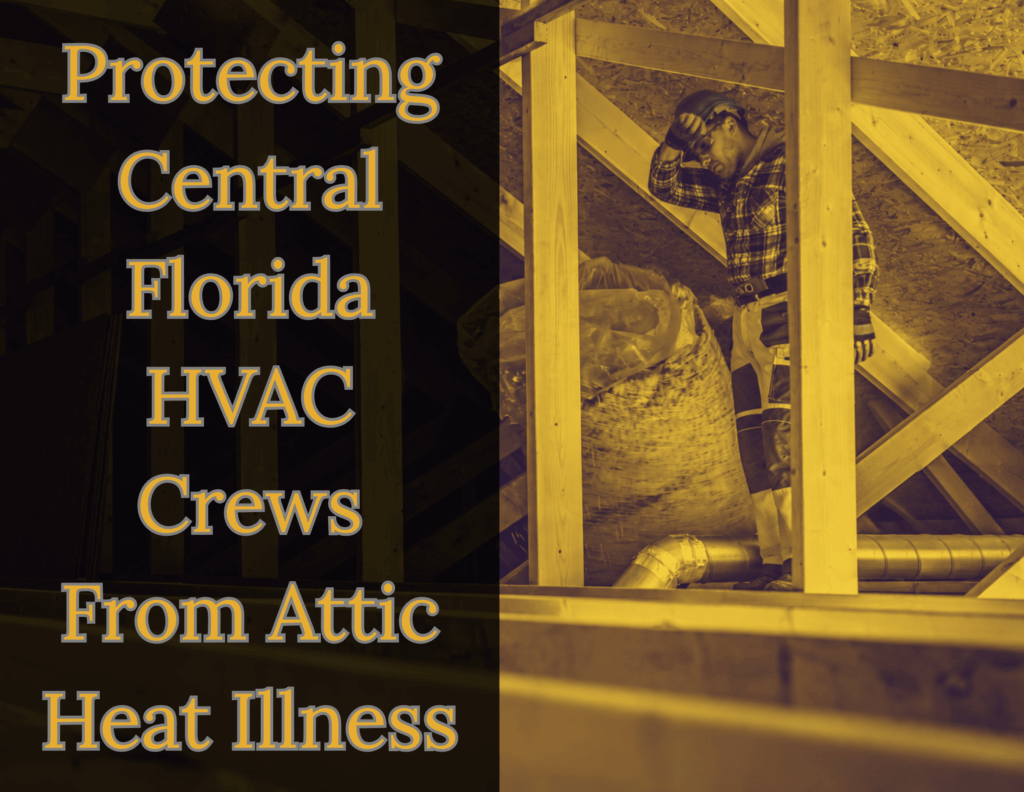
HVAC Heat Illness Prevention Is a Serious Responsibility
HVAC heat illness prevention is a serious responsibility for contractors operating in Central Florida.
Technicians working in Polk County, Osceola County, and Highlands County regularly enter attics containing extreme heat, high humidity, limited airflow, insulation, electrical equipment, and restricted access.
The technician may also be carrying tools, wearing protective equipment, moving equipment, brazing lines, or completing physically demanding repairs.
These conditions can affect the technician’s body much faster than the company owner, dispatcher, or customer realizes.
An employee who begins a job feeling fine may develop a headache, dizziness, nausea, weakness, confusion, or loss of coordination while working inside the attic.
That can become a medical emergency. It can also contribute to falls, electrical contact, damaged equipment, motor vehicle accidents, lost productivity, and workers’ compensation claims.
HVAC owners need a practical heat safety process that fits the way their technicians actually work.
Why Central Florida Attics Are Dangerous
Outdoor weather reports do not tell the entire story.
Sunlight heats the roof surface, and the attic traps heat underneath it. Limited ventilation can prevent the heat from escaping. High humidity also makes it harder for sweat to evaporate and cool the body.
The technician adds even more heat through physical labor.
OSHA explains that occupational heat exposure involves several factors, including temperature, humidity, physical activity, heat sources, air movement, clothing, and individual risk factors. Employers should evaluate the complete work environment instead of relying on one temperature reading.
Consider an HVAC technician replacing an attic air handler in Davenport.
The technician must climb through a small access opening, move across ceiling joists, remove the old unit, carry tools, and install new components.
Even if the outdoor temperature does not appear extreme, the combination of attic conditions and physical labor can create a serious heat exposure.
The same risk exists in older homes in Lakeland, Winter Haven, Sebring, and Avon Park, where attic access and ventilation may be limited.
Recognizing Heat Illness

Every technician, installer, supervisor, and dispatcher should know the warning signs of heat illness.
Signs of Heat Exhaustion Can Include:
- Headache
- Nausea
- Dizziness
- Weakness
- Irritability
- Thirst
- Heavy sweating
- Elevated body temperature
- Decreased urine output
NIOSH recommends removing a worker with possible heat exhaustion from the hot area, providing liquids, beginning cooling, and obtaining medical evaluation. Someone should remain with the worker while help is arranged.
Signs of Heat Stroke
Heat stroke is a medical emergency.
Possible warning signs include confusion, slurred speech, loss of consciousness, seizures, or very high body temperature. A worker may display poor judgment or refuse help because the heat is affecting their mental condition.
Call 911 immediately when heat stroke is suspected. Move the worker to a cooler area and begin active cooling while waiting for emergency responders.
Do not leave the worker alone.
Create a Written Attic Heat Safety Process
A general instruction telling technicians to “be careful” is not enough.
The company needs a written process explaining how work will be planned, monitored, and stopped when conditions become unsafe.
Evaluate the Job Before Attic Entry
The technician should evaluate the attic before bringing in every tool and beginning strenuous work.
Consider:
- Temperature and humidity
- Amount of air movement
- Attic access and exit route
- Expected time inside the attic
- Physical demands of the work
- Protective equipment and clothing
- Whether the technician will work alone
- Availability of a cooler recovery area
- Water and electrolyte availability
- Communication with the dispatcher or supervisor
A quick assessment can identify whether the work should be scheduled earlier, divided into shorter work periods, or assigned to two technicians.
Schedule Demanding Work Strategically
Central Florida contractors cannot avoid every afternoon attic call.
However, companies can schedule planned installations, changeouts, ductwork, and other demanding attic jobs earlier in the morning when possible.
Emergency service work may still require afternoon entry. In those situations, the company should adjust the work and rest schedule based on conditions.
A customer in Kissimmee may want the system restored immediately, but a rushed technician suffering from heat stress is more likely to make a mistake, damage equipment, or become seriously ill.
Explain that safe work protects both the technician and the customer’s property.
Provide Water and Cooling Breaks

Employers should make cool drinking water accessible and encourage workers to drink regularly instead of waiting until they feel thirsty.
OSHA advises frequent hydration and notes that workers performing longer jobs may also need access to electrolyte containing beverages. Rest breaks should become longer or more frequent as heat stress increases.
For an HVAC company, a cooling break should mean leaving the attic.
Sitting beside the air handler for two minutes does not provide meaningful relief from the heat source.
The technician should exit to an air conditioned vehicle, shaded area, or another location that allows the body to recover.
Managers should avoid creating a culture where employees feel weak or lazy for taking a required safety break.
Use a Buddy System or Required Check Ins
Attic work can isolate a technician from the customer and other employees.
If the technician becomes confused, faints, or falls, nobody may immediately recognize the emergency.
Use two technicians for demanding or high risk attic work when practical.
When someone must work alone, establish required check in times with the dispatcher or supervisor.
The process should document:
- When the technician enters the attic
- The expected work period
- The next check in time
- How the technician will communicate
- What happens after a missed check in
- Who can safely enter or call emergency services
A missed check in should trigger action. It should not be treated as a routine scheduling delay.
Protect New and Returning Technicians
A new employee may be technically capable but physically unprepared for repeated attic exposure.
Workers can also lose heat tolerance after vacation, illness, time away from the job, or a cooler season.
OSHA recommends gradually increasing heat exposure for new workers and employees returning to hot conditions. New workers should receive more frequent breaks, closer monitoring, training, and protection during their adjustment period.
This matters for growing HVAC companies in Haines City, Davenport, and St. Cloud that hire additional technicians during busy summer months.
A new employee may feel pressure to prove themselves. Supervisors should make it clear that reporting symptoms and following required breaks are job expectations.
Common HVAC Heat Safety Mistakes
1. Relying Only on the Outdoor Temperature
The outdoor temperature does not reflect attic heat, air movement, physical workload, or personal protective equipment.
2. Waiting Until the Technician Feels Thirsty
Thirst should not be the company’s hydration trigger. Water should be available and consumed regularly.
3. Allowing Employees to Skip Breaks
A technician who wants to finish quickly may skip a necessary cooling break. Required safety procedures should not be optional.
4. Sending Technicians Into Attics Without Monitoring
A lone technician needs scheduled communication and a reliable emergency process.
5. Ignoring New Worker Acclimatization
Age, fitness, or confidence does not guarantee heat tolerance.
6. Treating Confusion as Bad Behavior
Confusion, unusual irritability, poor coordination, or slurred speech may signal a serious medical emergency.
7. Failing to Document Training
If an incident occurs, the company should be able to show its heat safety policy, employee training, job planning, communication records, and corrective actions.
How Insurance May Respond
Workers’ Compensation
Workers’ compensation may apply when an employee suffers a compensable heat related illness or related injury during employment.
For example, a technician may experience heat exhaustion inside a Winter Haven attic. Another employee may become dizzy and fall through a ceiling. The claim could involve medical treatment, lost wages, investigation, and return to work planning.
Coverage depends on the circumstances and applicable policy.
General Liability
General liability generally addresses covered bodily injury or property damage involving others.
If a technician becomes disoriented and damages a customer’s ceiling, equipment, or property, the resulting allegations may involve general liability.
Coverage is still subject to policy terms, exclusions, and the cause of damage.
Commercial Auto
Heat exposure can continue after the technician leaves the attic.
An employee who is dizzy, weak, or confused should not immediately drive to the next service call.
Commercial auto coverage protects covered vehicles and driving exposures, but preventing an impaired employee from driving is the first priority.
Equipment Coverage
Equipment coverage, often written through inland marine insurance, may protect eligible tools and mobile equipment.
If heat illness contributes to dropped, damaged, or abandoned equipment, coverage will depend on the property involved, cause of loss, policy terms, limits, and deductible.
Action Steps for HVAC Owners
1. Create a Written Heat Plan
Explain job assessment, hydration, breaks, technician monitoring, emergency response, and incident reporting.
2. Train the Entire Team
Technicians are not the only employees who need training. Dispatchers and supervisors must recognize symptoms and know when to stop a job.
3. Stock Every Service Vehicle
Provide accessible cool water, appropriate electrolyte drinks, cooling supplies, emergency contacts, and first aid materials.
4. Establish Required Check Ins
Create a clear process for technicians entering isolated attics.
5. Schedule Planned Attic Work Earlier
Prioritize installations and labor intensive attic jobs during cooler parts of the day when possible.
6. Protect New and Returning Workers
Gradually increase their heat exposure and provide closer supervision.
7. Review Insurance and Claims Procedures
Review workers’ compensation, general liability, commercial auto, and equipment coverage with an insurance advisor who understands HVAC operations.
Frequently Asked Questions
1. How Hot Is Too Hot for HVAC Attic Work?
There is no single temperature that determines every situation. Temperature, humidity, airflow, workload, clothing, exposure time, and employee risk factors must be considered together.
2. How Often Should HVAC Technicians Take Cooling Breaks?
Break frequency should increase as heat stress and workload rise. The company should base its process on actual job conditions and current safety guidance rather than using one schedule for every attic.
3. Should a Technician Work Alone in a Hot Attic?
A buddy system is safer for demanding work. When one technician must work alone, use required check ins and an emergency response procedure.
4. What Should We Do When a Technician Shows Heat Exhaustion Symptoms?
Remove the technician from the hot area, begin cooling, provide frequent sips of cool water when appropriate, stay with the employee, and arrange medical evaluation. Call 911 if medical care is unavailable or the condition worsens.
5. Can Heat Illness Become a Workers’ Compensation Claim?
A work related heat illness or resulting injury may become a workers’ compensation claim. Coverage depends on the facts, medical findings, applicable law, and policy.
Protect Your HVAC Crew and Your Business
Attic heat should never be treated as something HVAC technicians simply have to tolerate.
Contractors serving Lakeland, Winter Haven, Haines City, Davenport, Kissimmee, St. Cloud, Sebring, Avon Park, Lake Placid, and surrounding Central Florida communities need a documented heat illness prevention process.
Wise Insurance Agency helps contractors evaluate the connection between jobsite safety and their general liability, workers’ compensation, commercial auto, and equipment coverage.
If you own an HVAC company in Polk County, Osceola County, or Highlands County, contact Wise Insurance Agency to review your risks and identify possible coverage gaps before an attic emergency affects your employee and business.