Safe roof cleaning practices protect employees, customers, property, and the pressure washing business itself.
A roof cleaning project may appear straightforward. Apply the cleaning solution, allow it to work, rinse when appropriate, and document the results.
The actual job can involve elevated work, ladders, slippery surfaces, fragile roofing, skylights, power lines, chemicals, hoses, wind, heat, lightning, landscaping, pools, vehicles, and neighboring property.
One overlooked hazard can result in a serious fall, chemical exposure, customer injury, damaged roof, dead landscaping, contaminated pool, or costly insurance claim.
Pressure washing and soft wash contractors serving Polk County, Osceola County, and Highlands County need a written safety process that addresses the entire job.
Roof Cleaning Safety Begins on the Ground
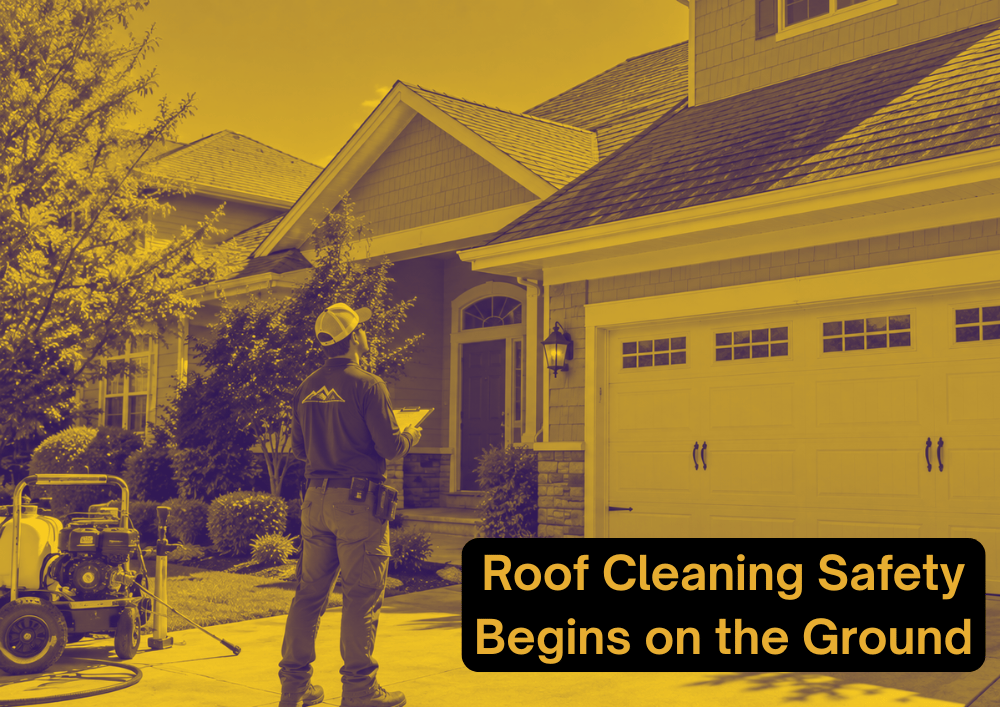
The safest time to identify roof hazards is before an employee climbs the ladder.
Complete a property and roof assessment from the ground. Use safe observation methods and available property information to identify:
- Roof material
- Roof pitch
- Height and access points
- Skylights and roof openings
- Solar panels
- Power lines
- Damaged or loose roofing
- Soft or deteriorated areas
- Gutters and downspouts
- Trees and other obstructions
- Landscaping
- Pools and water features
- Vehicles
- Pedestrian areas
- Neighboring property
The assessment should answer an important question:
Can the work be completed safely from the ground or another protected location?
Eliminating unnecessary roof access can remove a major fall exposure. Do not require an employee to walk a roof merely because it is faster or because the company has always done it that way.
Understand Which Safety Rules Apply
Roof cleaning work can fall under different workplace safety requirements depending on the employer, work activity, jobsite, and whether the work is considered maintenance or construction.
OSHA’s general industry walking and working surface rules address fall protection for employees working at elevation. Construction activities are addressed by separate construction fall protection standards.
Contractors should determine which rules apply to their operations and create a compliant plan for each job.
Source: Occupational Safety and Health Administration, Fall Protection and Falling Object Protection
https://www.osha.gov/laws-regs/regulations/standardnumber/1910/1910.28
Source: Occupational Safety and Health Administration, Construction Fall Protection
https://www.osha.gov/laws-regs/regulations/standardnumber/1926/1926.501
Simply purchasing harnesses does not create a complete fall protection program.
Build a Complete Fall Protection System
A personal fall arrest system generally involves more than one piece of equipment.
The contractor must evaluate:
- Anchorage
- Full body harness
- Connecting device
- Clearance below the worker
- Swing fall exposure
- Equipment compatibility
- Equipment inspection
- Employee training
- Manufacturer instructions
- Rescue planning
An improperly selected anchor or connecting device can cause the system to fail or allow the employee to strike a lower surface.
Equipment should be used only for its intended purpose and according to the manufacturer’s instructions.
Workers must understand how to inspect, fit, connect, and use the equipment. Damaged or questionable equipment should be removed from service according to applicable requirements and manufacturer guidance.
Plan for Rescue Before a Fall
Calling 911 should not be the company’s only rescue plan.
A worker suspended after a fall may require prompt assistance. The company should determine how a rescue can be performed without exposing additional employees to a fall.
The plan should identify:
- How help will be requested
- Who is trained to respond
- What equipment is available
- How rescuers will avoid additional exposure
- How emergency responders will access the property
- Who will meet responding personnel
- How the incident will be reported
Crews working in more rural areas of Highlands County should consider whether emergency response time or property access creates additional concerns.
Inspect and Secure Every Ladder
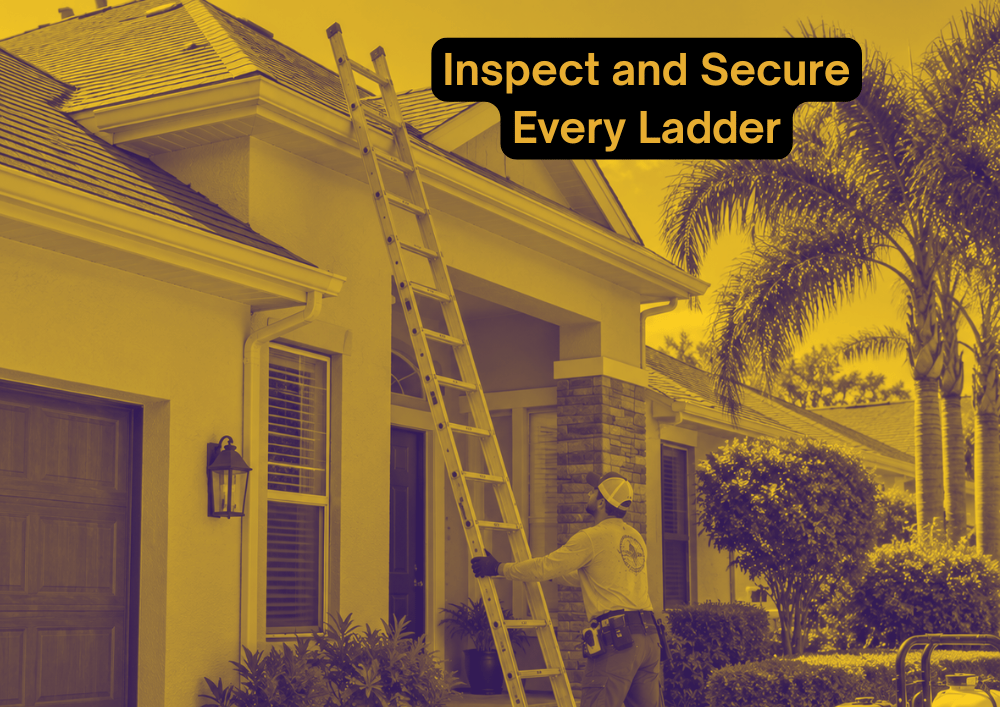
The ladder is often the first and last elevated surface used during the job.
Inspect it before use. Look for damaged rails, missing feet, loose hardware, contamination, damaged rungs, and other visible defects.
Choose a ladder designed for the work and load. Place it on a stable, level surface and secure it against movement.
Employees should face the ladder and maintain appropriate contact while climbing. They should not carry chemicals, tools, or equipment in their hands while climbing.
OSHA’s ladder requirements address ladder condition, use, positioning, load, and access.
Source: Occupational Safety and Health Administration, Ladders
https://www.osha.gov/laws-regs/regulations/standardnumber/1910/1910.23
A ladder placed on loose soil, wet landscaping, decorative stone, or an uneven driveway can shift unexpectedly.
Inspect the entire setup before anyone climbs.
Recognize Slippery and Fragile Surfaces
A roof may become more dangerous as cleaning progresses.
Water, detergent, algae, and cleaning solution can reduce traction. Hoses can create trip hazards, catch around vents, or pull against a technician.
Tile can crack or shift. Metal roofing may become extremely slippery. Skylights may not support a person’s weight. Existing roof damage can create soft or unstable areas.
The crew should establish:
- Approved walking areas
- Hose positioning procedures
- Communication between ground and roof workers
- Restricted areas
- Procedures for stopping application
- A method for keeping equipment from pulling against the employee
A technician should never walk backward toward an edge while focusing only on the cleaning pattern.
Monitor Central Florida Weather
Roof cleaning contractors in Lakeland, Winter Haven, Haines City, Davenport, Kissimmee, St. Cloud, Sebring, Avon Park, and Lake Placid face intense sun, heat, wind, sudden rain, and frequent lightning.
Check the weather before the job and continue monitoring conditions.
A weather application can provide useful information, but employees must also observe actual conditions at the property.
Create clear rules for:
- Wind
- Rain
- Lightning
- Wet roofing
- Extreme heat
- Poor visibility
- Approaching storms
Employees should not feel pressured to remain on a roof because the company wants to complete one more job.
Address Heat Exposure
Roof surfaces can absorb and reflect heat. Employees may also wear protective clothing and fall protection equipment while performing physical work.
Heat can contribute to dizziness, weakness, confusion, poor judgment, and loss of coordination. Those symptoms become especially dangerous on an elevated surface.
OSHA recommends providing water, rest, cooling, training, and additional protections as heat stress increases.
Source: Occupational Safety and Health Administration, Heat Exposure
https://www.osha.gov/heat-exposure
Schedule demanding work earlier when practical. Provide accessible drinking water and appropriate cooling breaks.
An employee showing signs of heat illness should be removed from the exposure and should not continue climbing or driving.
Control Roof Cleaning Chemicals
Pressure washing and soft wash contractors may use sodium hypochlorite, surfactants, detergents, and specialty cleaning products.
Every chemical should be:
- Properly labeled
- Used according to manufacturer instructions
- Stored securely
- Transported safely
- Supported by an accessible Safety Data Sheet
- Mixed only according to approved procedures
- Used with appropriate personal protective equipment
OSHA requires employers using hazardous chemicals to maintain a hazard communication program that includes container labels, Safety Data Sheets, and employee training.
Source: Occupational Safety and Health Administration, Hazard Communication
https://www.osha.gov/hazcom
The Centers for Disease Control and Prevention warns against mixing bleach with other cleaners or disinfectants because dangerous vapors may be released.
Source: Centers for Disease Control and Prevention, Cleaning and Disinfecting With Bleach
https://www.cdc.gov/hygiene/about/cleaning-and-disinfecting-with-bleach.html
Employees should never guess at a mixture or add an unidentified product to a tank.
Protect Customer and Neighboring Property
Roof cleaning solution can travel beyond the intended surface through overspray, wind, gutters, and downspouts.
Before starting, identify:
- Landscaping
- Vehicles
- Painted surfaces
- Decorative metals
- Outdoor furniture
- Doors and windows
- Pools and ponds
- Cameras and electronics
- Pets
- Neighboring property
Move property when practical. Control access to the work area. Follow product instructions for appropriate protection, application, and rinsing.
Use a small test area when working with an unfamiliar roof material, coating, paint, metal, or finish.
Photograph existing damage before work begins.
Control Chemical Runoff
Roof wash water can travel through gutters, downspouts, driveways, streets, ditches, storm drains, lakes, and canals.
The Florida Department of Environmental Protection explains that stormwater runoff can collect chemicals and sediment that may harm Florida’s rivers, lakes, and estuaries.
Source: Florida Department of Environmental Protection, Stormwater Program
https://floridadep.gov/water/stormwater
Contractors should not assume chemical wash water may enter a storm drain.
Requirements can vary by project, location, chemical, property type, drainage system, and local government. Determine what rules apply before beginning the job.
This is especially important near the lakes and waterways found throughout Polk County, Osceola County, and Highlands County.
Document Every Roof Cleaning Job
A complete job record may include:
- Property address
- Date and time
- Roof type and condition
- Access method
- Weather observations
- Fall protection used
- Ladder inspection
- Chemical and mixture information
- Property protection
- Before and after photographs
- Employee names
- Customer instructions
- Final inspection
- Any unusual conditions
Good documentation helps management evaluate safety, respond to complaints, and improve employee performance.
How Insurance May Respond
General Liability
General liability may respond to covered allegations involving bodily injury or property damage to customers or other third parties.
Examples may include damaged roofing, dead landscaping, chemical damage, water intrusion, or injury to someone near the work area.
Review exclusions or restrictions involving roofing operations, work performed at height, overspray, pollution, chemicals, property being worked on, and damage to the contractor’s work.
Workers’ Compensation
Workers’ compensation may apply when an employee suffers a compensable fall, chemical exposure, heat illness, eye injury, or other work related injury.
Accurate payroll and classifications are important. The carrier should understand that employees perform roof cleaning and may work at elevation.
Commercial Auto
Commercial auto may respond to covered accidents involving service vehicles.
Chemicals, ladders, tanks, hoses, and equipment should be secured properly during transportation. Personal auto insurance should not be assumed to cover regular commercial use.
Equipment Coverage
Inland marine or contractors equipment coverage may protect eligible pumps, tanks, hoses, ladders, trailers, and other mobile equipment.
Coverage depends on the property, limits, deductibles, causes of loss, security requirements, and exclusions.
Common Roof Cleaning Safety Mistakes
Treating Every Roof the Same
Roof material, pitch, condition, height, and access vary.
Assuming a Harness Is Enough
Fall protection requires appropriate equipment, anchorage, training, inspection, clearance, and rescue planning.
Failing to Inspect the Ladder
A damaged or unstable ladder can cause a fall before the technician reaches the roof.
Ignoring Skylights
Skylights and roof openings can present serious fall hazards.
Allowing Hoses to Control the Technician
Hoses should be positioned to reduce pulling, catching, and tripping.
Continuing Through Weather Changes
Wind, rain, lightning, and heat can make an acceptable job unsafe.
Failing to Confirm Insurance Operations
The policy must accurately reflect roof cleaning, chemicals, equipment, vehicles, employees, and work at elevation.
Action Steps for Contractors
1. Create a Roof Assessment Form
Document roof type, pitch, height, access, condition, obstacles, weather, and surrounding property.
2. Determine Whether Roof Access Is Necessary
Use a safer method when the work can be completed properly without walking the roof.
3. Establish a Fall Protection Program
Select appropriate equipment, anchorage, inspections, training, and rescue procedures.
4. Create a Ladder Checklist
Require inspection, correct positioning, securement, and controlled access.
5. Develop Weather Rules
Give employees clear stop work authority for heat, wind, rain, lightning, and unsafe surfaces.
6. Train Employees on Chemicals
Maintain labels, Safety Data Sheets, approved mixtures, protective equipment, and exposure procedures.
7. Photograph Every Job
Document conditions before and after cleaning.
8. Review Insurance
Review general liability, workers’ compensation, commercial auto, and equipment coverage with an advisor who understands roof cleaning operations.
Frequently Asked Questions
1. Is It Safe to Walk on Every Roof?
No. Roof material, condition, pitch, moisture, access, and fall protection must be evaluated. Some jobs should be completed from the ground or another protected location.
2. Is Wearing a Harness Enough?
No. A complete system also requires appropriate anchorage, connecting equipment, fit, inspection, clearance, training, and rescue planning.
3. Should Roof Cleaning Stop When It Rains?
Rain can increase slipping and affect chemical control. Work should stop whenever conditions make access, walking, application, or fall protection unsafe.
4. Can Roof Cleaning Chemicals Enter a Storm Drain?
Do not assume they can. Confirm the environmental and local requirements that apply to the property, chemical, runoff, and drainage system.
5. Does General Liability Cover Roof Damage?
It may respond to certain covered property damage allegations. Coverage depends on the policy language, exclusions, endorsements, limits, deductible, work performed, and facts of the claim.
Protect the Technician Before Cleaning the Roof
A clean roof is never worth an employee’s life or a preventable claim.
Safe roof cleaning practices require job planning, safe access, fall protection, ladder control, weather monitoring, heat prevention, chemical training, property protection, runoff control, and documentation.
Pressure washing and soft wash contractors serving Lakeland, Winter Haven, Haines City, Davenport, Kissimmee, St. Cloud, Sebring, Avon Park, Lake Placid, and surrounding Central Florida communities need safety procedures built around their actual operations.
Wise Insurance Agency helps pressure washing contractors connect safety with general liability, workers’ compensation, commercial auto, and equipment coverage.
Remember, follow Wise Insurance for more tips, tricks, and insurance insights. If you want to make sure your coverage is protecting you the way it should, call us at 863 534 3431 or message us for a policy review.
Coverage depends on policy language, endorsements, exclusions, limits, deductibles, and the circumstances of each claim.
Complete Sources
Occupational Safety and Health Administration, Fall Protection and Falling Object Protection
https://www.osha.gov/laws-regs/regulations/standardnumber/1910/1910.28
Occupational Safety and Health Administration, Construction Fall Protection
https://www.osha.gov/laws-regs/regulations/standardnumber/1926/1926.501
Occupational Safety and Health Administration, Ladders
https://www.osha.gov/laws-regs/regulations/standardnumber/1910/1910.23
Occupational Safety and Health Administration, Heat Exposure
https://www.osha.gov/heat-exposure
Occupational Safety and Health Administration, Hazard Communication
https://www.osha.gov/hazcom
Centers for Disease Control and Prevention, Cleaning and Disinfecting With Bleach
https://www.cdc.gov/hygiene/about/cleaning-and-disinfecting-with-bleach.html
Florida Department of Environmental Protection, Stormwater Program
https://floridadep.gov/water/stormwater